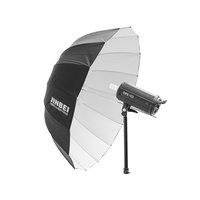
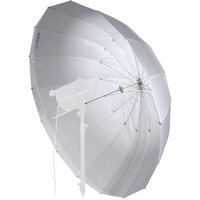
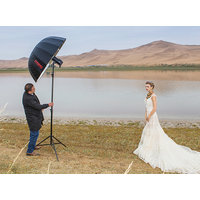
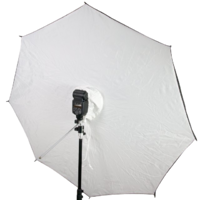
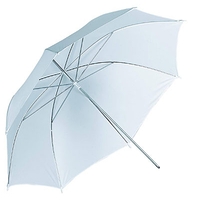
Photography umbrellas provide fast, lightweight light shaping for portraits, groups, products and straightforward studio setups. Choose shoot-through, reflective, deep parabolic and softbox-style umbrellas for studio flash or compatible continuous lights from Jinbei, Nanlite and PROLUX.
An umbrella opens in seconds and creates a much larger apparent light source than a bare reflector. It is easy to reposition, packs into a narrow bag and works well for photographers who need broad, forgiving illumination without a complex modifier assembly.
A translucent white umbrella is positioned with its outer curve facing the subject so the light passes through the fabric. Shoot-through umbrellas create wide coverage and can be placed close to the subject for soft light. Some output also spills backward, so they are best used where broad illumination is acceptable.
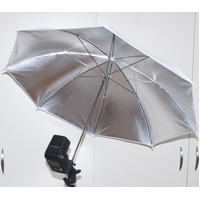
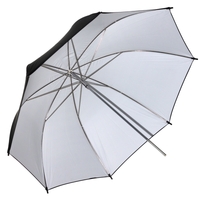
A reflective umbrella points away from the subject and bounces the light back from its interior. White interiors create a softer, more neutral reflection, while silver interiors generally provide greater efficiency and a crisper quality. A black backing helps prevent light from transmitting through the umbrella.
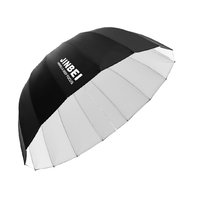
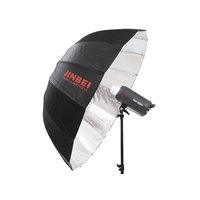
Deep umbrellas surround the light more than a shallow design and can provide improved direction and a more focused reflection. Moving the light along the umbrella shaft changes how the surface is filled, affecting beam spread and contrast. These modifiers are popular for portraits and fashion lighting.
Softbox-style umbrellas combine an umbrella frame with front diffusion or an enclosed reflective design. They retain quick setup while controlling more spill than a standard umbrella. Check whether diffusion and backing materials are included and how they attach.
Larger umbrellas create a broader source and cover bigger subjects, but require more space and stronger support. Compact models suit headshots and small rooms. Medium and large umbrellas are useful for groups, full-length portraits and softer wrap. Confirm the shaft diameter and the fixture or umbrella-bracket capacity.
Place the umbrella close enough to appear large from the subject while keeping it outside the camera frame. Fill the surface evenly without pushing the flash or light so far forward that output misses the umbrella. Meter the final setup because the fabric, size and bounce direction all affect exposure.
Umbrellas create significant leverage on a stand and can catch wind easily. Use a stable support, tighten the bracket, position a stand leg beneath the load and add a sandbag. Outdoor use requires close supervision and conservative wind limits. Maintain safe heat and ventilation clearance around continuous fixtures.
Compare shoot-through, white reflective, silver reflective, deep parabolic and softbox umbrellas by diameter, surface and packed size. PROtog supplies portable options for studio flash, speedlights and compatible continuous lighting systems.
White gives a softer, more neutral reflection. Silver is generally more efficient and creates a crisper, higher-contrast result.
A reflective umbrella bounces light back toward the subject. A shoot-through umbrella transmits light through white fabric and usually spreads it more widely.
Yes, when the fixture or bracket has a compatible umbrella receiver and the shaft does not obstruct ventilation. Check the light’s instructions and support capacity.
A medium umbrella around 100–130cm is versatile for individual portraits. Larger sizes give broader coverage, while smaller models are easier to use in confined spaces.

Simple instalment plans available instantly at checkout


Use your existing debit or credit card

No long forms, instant approval online

Pay fortnightly, enjoy your purchase straight away!
All your need is:
1) An Australian Visa or Mastercard debit/credit card; 2) To be over 18 years of age; 3) To live in Australia
To see Afterpay's complete terms, visit https://www.afterpay.com.au/terms
© 2026 Afterpay