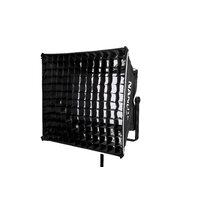
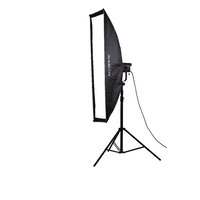
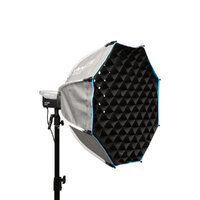
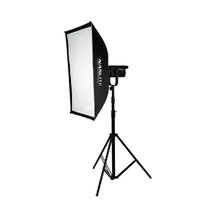
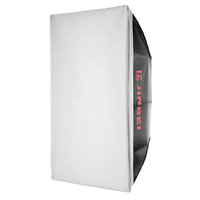
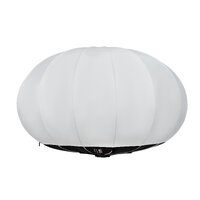
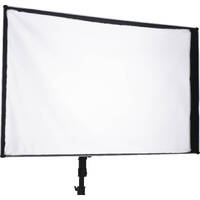
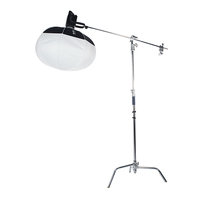
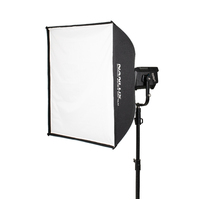
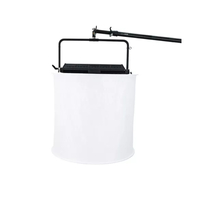
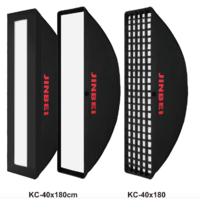
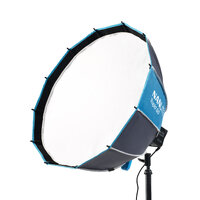
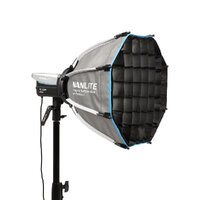
Softboxes create broad, controlled light for portraits, products, interviews, filmmaking and studio production. By enclosing the beam and passing it through one or more diffusion layers, a softbox produces smoother shadow transitions and more predictable reflections than a bare fixture. Explore rectangular, strip, octagonal, parabolic, lantern and rapid-fold softboxes for flash and continuous lights from Jinbei, Nanlite, Nanlux and PROLUX.
A softbox increases the apparent size of a light source while controlling spill with opaque side walls. The reflective interior redirects output toward the front diffusion, helping create an even illuminated surface. Larger softboxes placed close to the subject generally produce softer light, while deeper or more directional designs can maintain contrast and throw.
Rectangular softboxes are versatile choices for portraits, interviews and product photography. Their straight edges can create window-like catchlights and make it easier to control reflections on glass, metal and glossy surfaces.
Long, narrow strip boxes are useful for rim light, edge light, full-length portraits and controlled highlights on products. Add a compatible grid when you need to reduce sideways spill without changing the softbox’s overall shape.
Octagonal softboxes create rounded catchlights and broad wraparound illumination. Deep parabolic designs place the light farther inside the modifier and can provide a more focused, dimensional quality while retaining soft transitions.
Lantern softboxes spread light through a wide angle for rooms, overhead rigs, interviews and ambient fill. Skirts or directional accessories can be used where available to limit spill toward walls, ceilings or camera.
Rapid-fold mechanisms reduce assembly time for location work and frequently changing sets. Umbrella-style, quick-release and integrated-frame designs pack down without requiring individual rods to be installed. Check the packed size, mechanism and included bag when transport speed matters.
Always match the softbox mount to the fixture. Bowens S-type, FM, NL, FE, BE and manufacturer-specific panel mounts are not interchangeable. Some softboxes are designed for one fixture series, while others accept replaceable speed rings. Confirm the mount, supported models, maximum heat rating and whether an adaptor is included.
Many softboxes include inner and outer diffusion layers. The inner baffle helps reduce a central hot spot, while the front diffuser creates the final emitting surface. Removing a layer can increase output and contrast. A grid narrows the effective spread and helps keep light off backgrounds or nearby surfaces. Browse dedicated lighting grids when the grid is sold separately.
Choose a size that is appropriate for the subject and working distance. Compact modifiers suit tight spaces and close product work. Medium softboxes are versatile for headshots and interviews, while large softboxes cover groups, full-length portraits and larger sets. Consider ceiling height, stand capacity, wind exposure and how much fixture output is available.
Use a stand, boom or rig rated for the combined fixture and modifier load. Sandbag the support, keep the weight over a stable leg and attach safety restraints where required. Large softboxes can catch wind outdoors and should be lowered if conditions become unsafe. Maintain the fixture manufacturer’s ventilation and heat-clearance requirements.
Compare softboxes by shape, diameter, depth, mount, included diffusion, grid compatibility and packed size. PROtog supplies professional options for COB lights, LED panels, studio flash and portable lighting, with compatible grids and mounting accessories available separately.
Use a modifier large enough to appear broad from the subject’s position. A larger softbox close to the subject gives softer light; a smaller or more distant modifier produces harder shadows and greater contrast.
Only when the fixtures share a compatible mount or the softbox accepts a replaceable speed ring. Check the exact mount and supported fixture models before ordering.
A grid reduces off-axis spill and makes the light easier to direct while preserving much of the softbox’s frontal softness. It does not make the emitting surface smaller.
Sometimes, but the mount and heat rating must be compatible. Use only modifiers approved for the fixture type and maintain the required ventilation clearance.

Simple instalment plans available instantly at checkout

Use your existing debit or credit card

No long forms, instant approval online

Pay fortnightly, enjoy your purchase straight away!
All your need is:
1) An Australian Visa or Mastercard debit/credit card; 2) To be over 18 years of age; 3) To live in Australia
To see Afterpay's complete terms, visit https://www.afterpay.com.au/terms
© 2026 Afterpay